
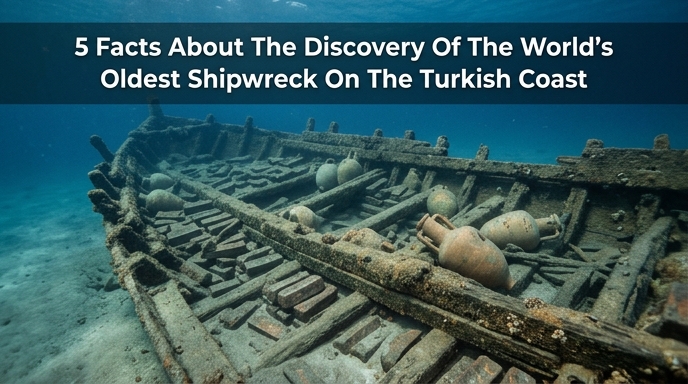
For all you netizens who love scrolling through cool trivia, you definitely need to peep this out! Archaeologists just dropped some super mind-blowing news straight from the bottom of the Mediterranean Sea. An ancient shipwreck estimated to be around 4,400 to 4,700 years old has been discovered off the coast of Turkey! Hailing from the Early Bronze Age, this find is officially the world’s oldest shipwreck ever identified so far.
No cap, this trading ship is literally from the same era as the construction of the Great Pyramid of Giza in Egypt! Even though the ship’s wooden structure has long decomposed, tons of super valuable artifacts inside are still chilling and well-preserved at the seabed.
A Quick Sneak Peek Into the Discovery of the World’s Oldest Shipwreck
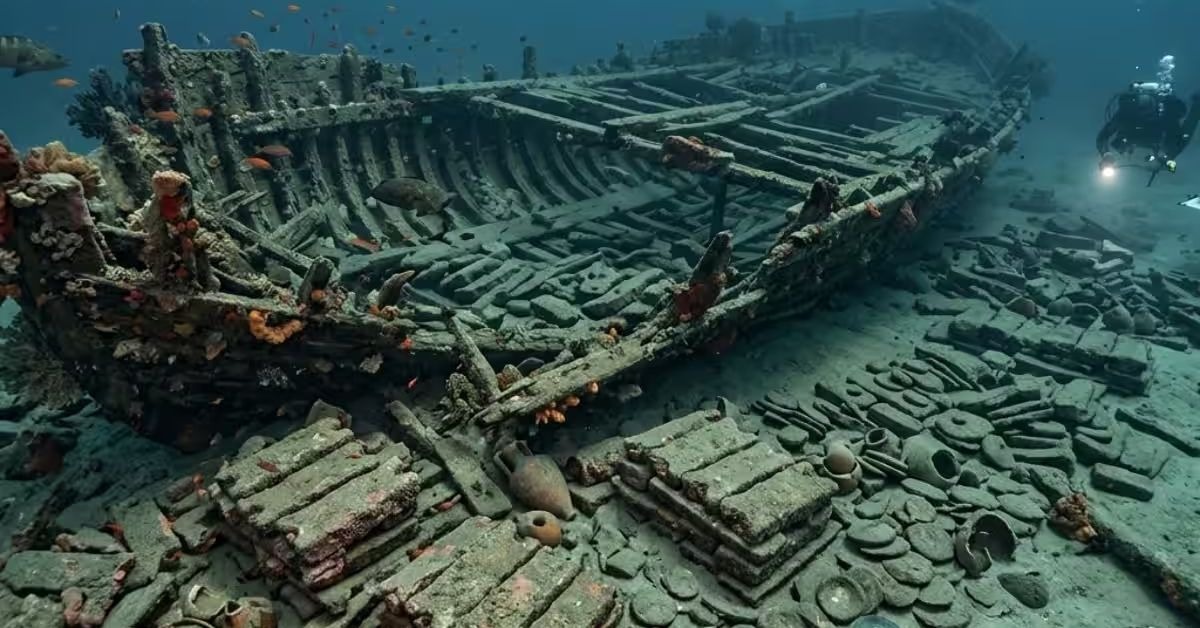
The underwater archaeology world was just shook when an expedition by the Mediterranean Archaeological Association, led by Prof. Hakan Öniz from Akdeniz University, Turkey, managed to identify these ancient sailing remains. This 10-meter trading ship was back in the day used to cruise the Mediterranean Sea to haul cargo and commodities between regions.
Even though it’s been sunken for thousands of years, the area surrounding the wreckage still holds hyper-valuable traces of civilization. This discovery immediately grabbed the science world’s spotlight because it gives us a crystal-clear look at how lit the sea trade routes were for Early Bronze Age humans.
5 Facts About the Discovery of the World’s Oldest Shipwreck on the Turkish Coast
Wanna know the juicy details and facts behind this find? Let’s spill everything right down below:
1. Dating Back to the Early Bronze Age
The first fact that’ll honestly make your jaw drop is the ship’s age. Based on expert analysis, the vessel is estimated to have sunk between 4,400 and 4,700 years ago. That means this ship was already sailing the open oceans back when ancient folks were literally just starting to build the Great Pyramid of Giza!
Prof. Hakan Öniz stated that this discovery is 100% from the Early Bronze Age. It proves that long-distance maritime navigation was already a massive thing long before modern civilization even dreamed up advanced tech like we have today.
2. Found 30 Meters Deep Near Kekova Island
The exact spot of this shipwreck is near the coast of Kekova Island, located in the Antalya region of Turkey. The artifacts are scattered across an underwater slope that isn’t too deep, sitting at only about 30 meters beneath the sea surface.
Since the depth is pretty chill for underwater archaeology standards, the diver squad could easily document and analyze the artifacts with high-key precision without stressing over extreme deep-sea pressure.
3. Divers Discovered 3 Stone Anchors and Dozens of Amphorae
When the divers swam down to the seabed, they stumbled upon a view that was both aesthetic and historical AF. There were three massive stone anchors resting near the wreck site. According to researchers, long-haul ships back then casually carried spare anchors just in case of emergency vibes out in the open sea.
Not just anchors, the divers also scored over 30 ancient ceramic storage vessels known as amphorae. The coolest part? Some of these storage pots still kept traces of the actual goods they were carrying thousands of years ago!
4. The Secret to Dating Without Wood Material
A lot of people are probably wondering, how do researchers figure out the ship’s age if all the wood is completely gone? Since there’s zero organic material left, the usual radiocarbon dating method is a total no-go.
|
Age Determination Parameter |
Archaeological Analysis Method |
|---|---|
|
Main Method |
Typology & Ceramic Design Characteristics (Amphora) |
|
Artifact Physical Traits |
Has 2 handles, a bulge in the middle, and a flat base |
|
Factual Comparison |
Matches Egyptian & Middle Eastern pottery designs aged 4,400–4,700 years |
Pottery-making styles are always evolving over time. By matching the decoration techniques and the shape of the Kekova amphorae with similar artifacts in Egypt and Middle East regions, Prof. Hakan Öniz and his crew locked down the exact time period with precision!
5. Acting as a Time Capsule of Ancient Trade Routes
Professor Hakan Öniz low-key compares this find to an “underwater time capsule.” The presence of ceramic cargo and the 10-meter ship structure totally proves that the Mediterranean trade network was super active and organized all the way back in prehistoric times.
Every single item resting on the Kekova seabed serves as hard proof of how intense the economic, cultural, and technological interactions were among ancient civilizations across the Mediterranean region.
FAQ About the World’s Oldest Shipwreck
Where is the exact location of the world’s oldest shipwreck?
This ancient shipwreck was found on an underwater slope at a depth of 30 meters near the coast of Kekova Island, Antalya, Turkey.
Why is there no wood left of the ship at the seabed?
The ship’s wooden structure completely decayed and decomposed naturally due to seawater exposure and microorganisms over a span of more than 4,500 years.
Who is the expert leading this discovery expedition?
The expedition was led by Prof. Hakan Öniz from Akdeniz University, Turkey, in collaboration with the Mediterranean Archaeological Association.
This epic discovery on the Turkish coast totally opens our eyes to how massive and mystery-packed Earth’s history really is. This underwater time capsule off Kekova really flexes how insanely smart our ancestors were thousands of years ago. If you’re into science topics and ancient history, this find is definitely a must-add to your reading list!
About the Author