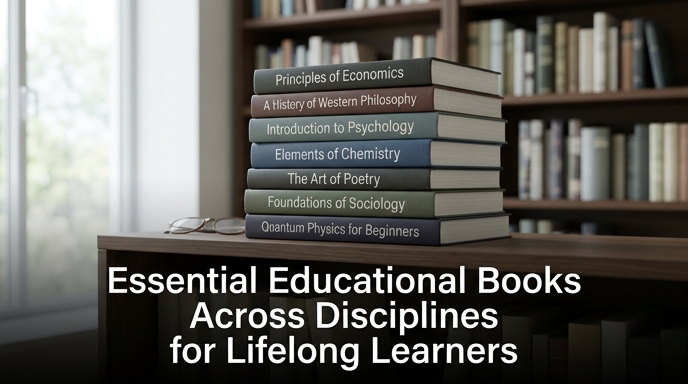
Building a solid intellectual foundation requires access to structured reading materials. The presence of various educational books provides self-directed learners with the space to systematically explore concepts in science, humanities, and critical thinking methodologies. Reading high-quality literature helps individuals connect abstract ideas with real-world applications in daily life. Selecting the right books not only broadens academic horizons but also sharpens analytical thinking in dealing with the evolving dynamics of knowledge.
Lifelong learning requires a curated selection of reading materials that prioritize depth of content and methodological clarity. Non-fiction books and academic guides offer structured roadmaps for understanding the framework of knowledge from foundational to advanced levels. Learners can establish efficient self-study strategies by filtering references based on disciplines and their cognitive impact. Let us explore how essential literary references can help build a strong, analytical mindset.
The Role of Foundational Literature in Shaping Critical Thinking Frameworks
 Reading foundational reference works provides a solid groundwork before delving into more specialized discussions. Foundational academic books typically present historical analyses of scientific developments, theoretical baselines, and in-depth methodological critiques. Mastering these fundamentals prevents logical fallacies and accelerates comprehension when studying more complex topics.
Furthermore, literature authored by experts in Higher Education often includes real-world case studies as evaluation materials. This approach trains readers not merely to memorize facts, but to analyze the underlying reasons behind phenomena. Individuals develop a more mature evaluative capability when encountering complex information in both professional and academic environments.
Strengthening STEM Education Literacy and Scientific Approaches
Mastering science, technology, engineering, and mathematics disciplines is a fundamental necessity in modern academic landscapes. Specifically, quality works in STEM Education present quantitative concepts logically and digestibly without compromising scientific rigor. Readers should understand reasoning pathways, hypothesis testing, and systematic data processing.
Additionally, well-structured science references always connect mathematical formulas or physical laws with practical applications. Explanations of scientific methodology help learners develop evidence-based thinking patterns. Consequently, through references in the best educational books list, anyone can hone the problem-solving skills highly sought after across various industries.
Humanities and Pedagogy as Solutions for Understanding Social Dynamics
An understanding of natural sciences remains incomplete without being balanced by humanities insights and learning theories. Books covering Pedagogy concepts offer deep insights into how humans absorb information, construct memory, and form perceptions. This knowledge is valuable for educators, parents, and individuals seeking to enhance the efficiency of their self-study process.
Moreover, literature in philosophy, sociology, and history expands perspectives on human interaction and the progression of civilization. Studies in these fields foster social empathy and cognitive flexibility when confronting diverse ideas. Therefore, integrating technical expertise with humanities insights cultivates a well-balanced, broad-minded learner profile.
Practical Steps to Design a Book-Based Self-Study Plan
Enjoying the self-study process requires careful planning so that comprehension builds gradually. Establishing a clear reading itinerary helps maintain focus and consistency when tackling dense subject matter.
- Identify the core discipline you wish to study and the target outcomes you aim to achieve from the learning process.
- Select introductory-level books that present comprehensive topic coverage before advancing to specialized analytical works.
- Create concise summaries or concept maps upon completing each chapter to test your level of comprehension.
- Compare ideas from two or more different authors to gain a richer, more balanced perspective.
- Periodically assess your understanding by re-explaining complex concepts in your own simpler terms.
Implementing a structured study workflow makes reading feel more purposeful and yields tangible results. Every reading session will contribute positively to your long-term intellectual growth.
Sustaining Learning Consistency Through the Best Book Selections
Personal capacity development through reading is a long-term investment that is never in vain. Choosing references from the top educational books list guides us to continuously explore knowledge efficiently and enjoyably. Successful self-study relies heavily on discipline and the quality of reading sources used as daily benchmarks. Keep expanding your intellectual horizons by reading a variety of educational books for learners and achieve meaningful lifelong learning.
How do I choose an educational book suited to my initial level of understanding?
Opt for books that include basic introductions in the opening chapters without jumping straight into complex technical jargon. You can also examine the table of contents and academic reviews to ensure the material is structured for beginners or intermediate learners.
Why is reading physical books or structured digital formats more effective than short articles?
Books present complete, comprehensive, and methodologically vetted trains of thought from beginning to end. Short articles generally provide surface-level snippets of information, whereas books build deep and interconnected frameworks of thought.
Are topic-specific books suitable for non-academic self-learners?
Topic-specific books are highly suitable as long as the learner possesses a foundational grasp of the relevant discipline. Readers can consult glossaries or basic guides whenever encountering intricate concepts within the text.
How can one measure the impact of reading materials on personal development?
You can gauge reading effectiveness by your ability to explain complex topics simply, solve practical problems using theoretical frameworks, and evaluate new information more critically.
Where can we find high-quality educational book references?
You can discover quality references through university library catalogs, scholarly journals, reputable educational institute reviews, and official publications from the UNESCO Institute for Lifelong Learning. Independent book curation platforms also frequently feature recommendations structured by field of study.
About the Author