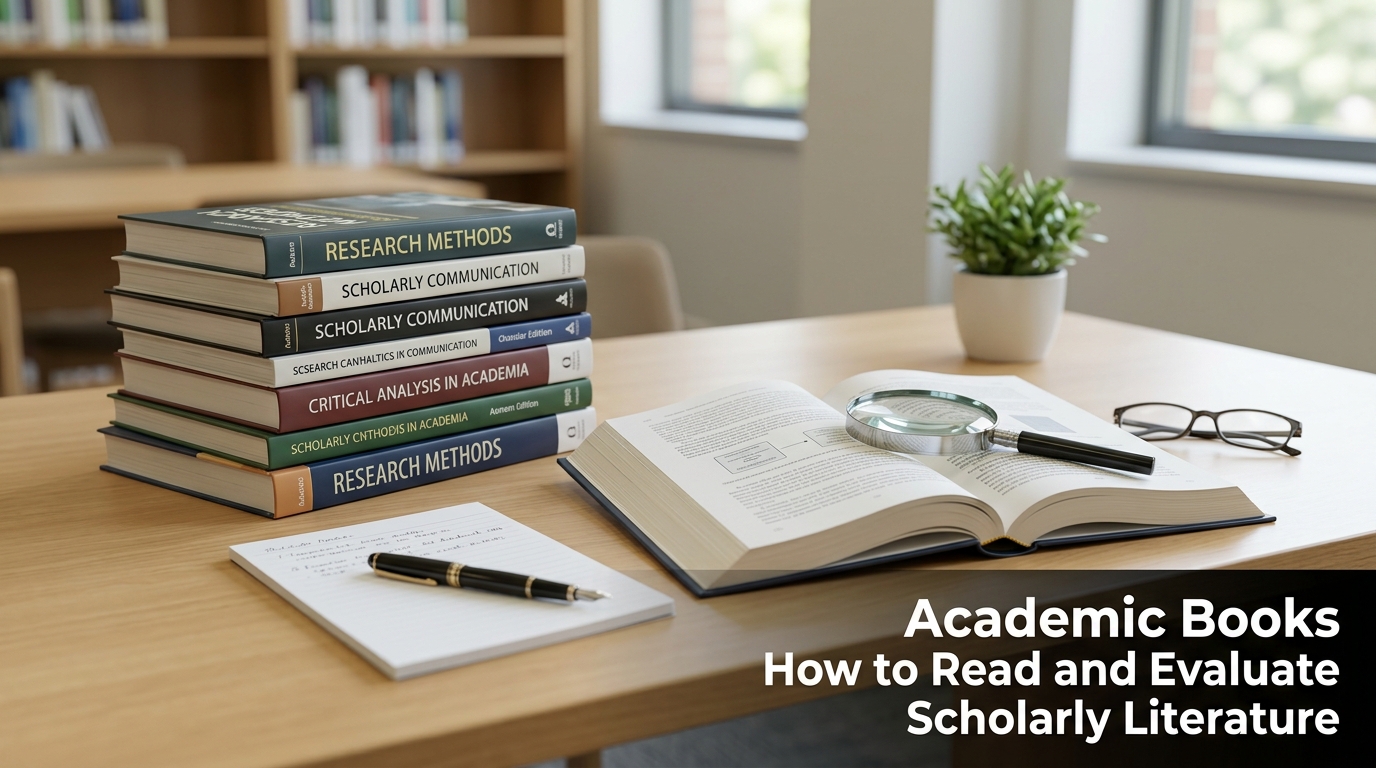
Completing a final thesis or writing a scholarly article requires reliable references that provide deep arguments. Many students feel overwhelmed when they have to examine dozens of international reference books in a limited amount of time. Learning how to study academic books strategically becomes the main key to finding the core of the research without having to read word for word from the front page to the back page.
Academic monographs present dense conceptual debates and highly structured methodologies. Therefore, having an analytical reading technique will make it easier for you to compose a sharp literature review while strengthening the theoretical foundation of your writing.
Basic Characteristics of Scholarly Publications and Academic Monographs

Scholarly works have a writing structure that is very different from fiction or popular non-fiction books. Authors compose text based on field data, deep theoretical reviews, and critical evaluations of previous scientists’ findings.
Prestigious publishers like universities usually apply a very strict peer-review process before printing a manuscript. This guarantees that every argument in scholarly academic books has methodological validity that can be accounted for. Understanding the anatomy of scholarly books makes you more confident in selecting high-quality references for college assignments and thesis proposals.
Synthetic Reading Strategies to Deconstruct Scholarly Books
Synthetic reading techniques allow researchers to extract main ideas from multiple sources simultaneously to answer specific research questions.
Deconstructing Structure Through a Three-Step Trick
An initial step that is very effective is checking the introduction, general conclusion, and table of contents. The opening chapter usually contains the main thesis, problem context, and an overall map of the book’s discussion. In addition, the concluding chapter presents a summary of the research implications and the limits of the findings achieved by the author.
Targeted Skimming of the Literature Review Section
When mastering how to read academic books, you do not need to be stuck reading every chapter at the same speed. Focus your attention on the first paragraph and the last sentence in each section because that is where the author formulates their core premise. Interestingly, this quick filtering method helps you discover important theoretical discourses without wasting a lot of time on less relevant technical details.
Finding the Best Sources for Research Needs
Searching for high-quality references requires precision in looking at the author’s track record and the relevance of the topic to your final project design.
- Prioritize books published by leading university presses or globally reputable scholarly associations.
- Browse the subject index at the end of the book to find specific terms you are currently researching.
- Check the bibliography inside the book to trace the primary literature that forms the foundation of the author’s thought.
- Choose the best academic books that have positive reviews in accredited academic journals in your field of expertise.
As information, sorting academic books for research based on publication year and citation counts makes it easier for you to map shifts in scientific paradigms over time.
Techniques for Writing Synthesis of Theory and Proper Citation
Critical reading must be accompanied by the ability to synthesize original arguments. You need to connect one theoretical perspective with another perspective to build a coherent flow of reasoning.
Avoid the habit of copying long sentences directly into your draft writing. Perform natural paraphrasing while still giving credit to primary and secondary sources according to the standard citation format required by your institution. On the other hand, using reference management software like Zotero or Mendeley will significantly minimize bibliography writing errors.
Applying Critical Reading Patterns in Study Routines
The success of advanced studies is heavily determined by your consistency in practicing analytical reasoning when dealing with complex literature.
Start by making concise notes containing three important points every time you finish reviewing a monograph chapter. Record the research questions asked by the author, the main evidence presented, and your critique of the methodological approach they applied. This disciplined step maintains your sharp thinking when you have to defend your research draft before an academic board of examiners.
Strategic Steps to Master Scholarly Reading Material
The expertise to navigate academic works is a long-term intellectual investment that is very valuable for students and researchers. Utilizing the right literature from academic books gives you a solid analytical foundation to produce high-quality publications. Apply this targeted reading strategy starting now on your research draft, and then develop your scientific arguments more convincingly.
Advanced Insights on Academic Literature
Why are academic books thicker and denser than popular books?
Academic books present in-depth analysis based on empirical data, strict methodological reviews, and comprehensive historical conceptual traces. This meticulous scientific approach requires comprehensive explanation space so that every claim has valid supporting evidence.
When should a student use a book rather than an academic journal?
Books are appropriate to use when you need a broad understanding of concepts, basic theoretical foundations, or a thorough summary of a scientific topic. Meanwhile, journal articles are more useful for examining recent data developments and specific experiments.
How to quickly determine if a book’s content is relevant to a thesis topic?
Check the abstract, introduction, and keyword index on the back pages of the book. If the key terms and methodological focus align with your problem formulation, then the book is worthy of being included in the primary reference list.
Is citing old monograph works still allowed in modern research?
Citing older publications is highly recommended if the book is a classic text or the initial foundation of the theory you are developing. You simply complement it with contemporary works to demonstrate the continuous progression of knowledge.
What is the best way to document quotes to avoid falling into plagiarism?
Rewrite the author’s ideas using your own sentence structure and vocabulary immediately after reading the relevant chapter. Include page number notes and the author’s name in your summary draft before transferring it into the main manuscript.
About the Author